
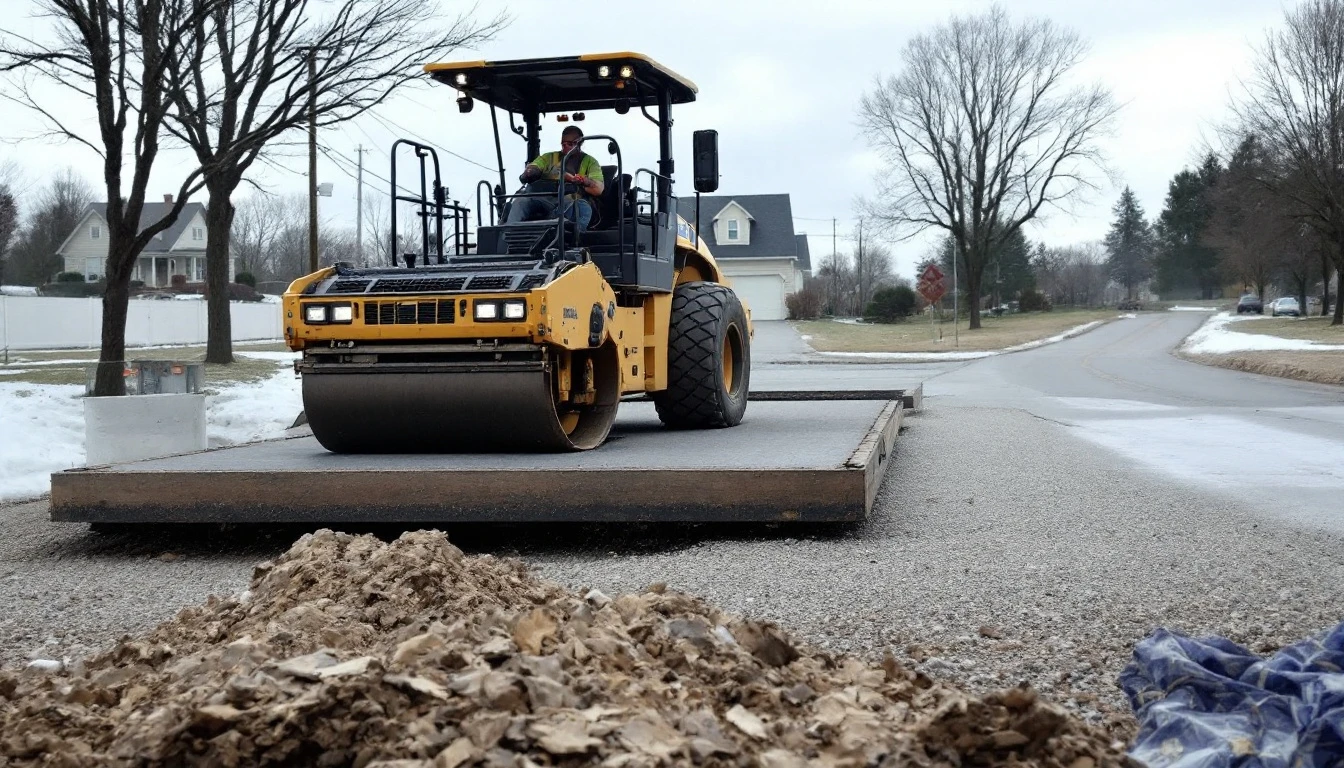
Here's something a lot of homeowners don't realize until it's too late, that is, you can pour a flawless asphalt or concrete driveway and still watch it crack, sink, or heave within a few years. It is not because the paving crew did bad work, but because nobody paid attention to what's underneath it. The subgrade is the native soil after it is prepared so it is firm and graded. The base is the structural aggregate under the surface. A subbase, when the design includes one, is another layer between the subgrade and the base. Many residential driveways have a prepared subgrade and a base and do not have a separate subbase. Asphalt, concrete, pavers, and permeable systems do not all use the same stack.
Why Sub-Base Is There the First Place
When a design includes a subbase, that layer is not just filler stone dumped into a hole. If done right, it spreads the weight of your car (or truck, or RV) across the soil underneath instead of letting that weight concentrate in one spot, giving the crew a stable surface to build on during construction. It also helps manage water so it doesn't sit and soften everything below. Weak soil, poor drainage, and frost are real risks. They do not mean every driveway has a separate subbase, and highway design guidance is not a residential code.
For example, picture a driveway poured straight over soft clay with none of the groundwork. It'll look great on day one. Then a few rainy seasons pass, cars keep rolling over it, and the clay starts shifting underneath. Cracks and dips show up in asphalt that was, technically, installed correctly. The surface wasn't the problem, what was underneath it never had a chance.
Look at the Soil Before You Touch the Stone
Before any gravel goes down, the existing ground needs a real look, such as soft or spongy spots, leftover organic matter, clay that swells when wet, areas that turn to mush under equipment. None of that should just get buried and paved over. It needs to be dealt with, whether that means digging it out, fixing drainage, adding a separation layer, or stabilizing the subgrade some other way. Which fix makes sense really comes down to what's actually going on at that specific spot.
Take a driveway that crosses a low patch where water tends to pool after a storm. Throwing extra stones at that problem doesn't fix the water. Instead, it just buries it, and the ground underneath can stay saturated and unstable no matter how much aggregate sits on top.
And before any digging starts, call to get utility lines marked, and check what your local jurisdiction actually requires for grading, drainage, and materials. Rules vary enough from town to town that a generic checklist online isn't a substitute for pulling your local requirements.
Picking the Right Stone
Not all gravel behaves the same way under a car.
Many conventional driveways specify dense-graded crushed aggregate because mixed sizes can lock when compacted. Where the design calls for open-graded aggregate, including some permeable pavements and drainage layers, do not add fines to make it dense-graded.
Recycled Concrete Aggregate
It can work fine, as long as it's been processed properly and meets spec. The question isn't recycled versus virgin stone, it's whether the material is clean and suitable for the job.
Skip Loose, Rounded Gravel and Dirty Fill
Round stones don't interlock the way angular crushed stone does, so they shift under repeated traffic instead of locking into a stable mass. Cutting corners on material quality here tends to cost more later, once settlement sets in.
How Thick Does It Need to Be?
A driveway over firm, well-draining soil needs a lot less structural buildup than one crossing wet clay, and a driveway that'll see delivery trucks or a boat trailer needs more than one built for a sedan.
Whatever the final answer, it has to account for every layer stacked on top, including the surface, base, and sub-base together. The worse the native soil, the deeper the excavation and prep work tends to run. Rather than grabbing a standard depth off a chart, the right number comes out of soil conditions, drainage, climate, surface type, and expected loads all together.
Compact in Layers, Not All at Once
This is where a lot of driveways quietly go wrong. Dumping a thick pile of stone into the excavation and only compacting the surface leaves the material underneath loose and uneven, no matter how solid the top looks. The better approach is to build it up in manageable lifts, compacting each one before adding the next.
Moisture matters here too. Too wet and the ground gets unstable. Too dry and the stone won't compact properly. Crews typically use vibratory plate compactors or rollers matched to the material and lift thickness. Compaction has to match the material and the moisture condition. FHWA's highway geotech manual calls soil compaction one of the most important geotechnical concerns in highway pavement construction. That is design guidance for highways, not a pass count or a Proctor percentage for a residential driveway.
Think of working over clay soil, compacting each lift before the next goes down, and you end up with a genuinely stable foundation. Pile several inches on at once and compact only the surface, and you can end up with weak pockets hidden beneath a driveway that looks perfectly fine.
Water Is the Real Issue
Water that stays in the soil or in the pavement layers can weaken support. Give surface water a path away from the house, and give water that enters the structure a way out, using the slope and drains the site actually needs. Slope, side drainage, swales, culverts, or edge drains are options the site may call for. They are not a required set for every driveway.
Low Spots Deserve Special Attention
If water keeps collecting on one side of the driveway, dumping in more stone won't solve it, the soil underneath just stays wet, and eventually even a well-compacted base can lose support from below. Drainage needs to get sorted before that last layer of aggregate goes down.
Geotextile can separate weak soil from clean aggregate so fines are less likely to migrate up. It does not replace excavation, grading, drainage, or compaction. FHWA highway guidance treats geosynthetics as a tool for defined weak-subgrade cases, and it says they do not fix expansive soils. Do not add fabric or geogrid on every job. Geogrid can help in the right weak-soil or heavy-load situation, chosen because the site calls for it.
Common Mistakes
- Paving over topsoil instead of removing it
- Choosing stone by price alone
- Skipping drainage planning
- Piling aggregate too thick between compaction passes
- Compacting only the top of a lift, not the whole thing
- Treating geotextile fabric as a fix for bad soil prep
- Covering soft spots instead of digging them out
- Using the same sub-base depth on every job regardless of conditions
None of this is about cramming more stone under the driveway for its own sake. It's about building a stable, well-drained foundation that actually fits the site.
Final Thoughts
Everyone notices the surface. Almost nobody thinks about what's holding it up, until it fails. Good soil prep, the right aggregate, careful lift-by-lift compaction, and real drainage planning are what actually determine whether a driveway lasts. There's no single formula that works everywhere. The best approach is the one built around your actual site, not a generic checklist.
At Drivewayz USA, we help homeowners think through exactly this, such as the materials, prep, drainage, and what it takes for a driveway to actually hold up over time. Whether you're planning new construction or troubleshooting a driveway that's already showing cracks or settlement, understanding what's happening below the surface is where it starts. For more on base layers, drainage, and subgrade prep, see the related Drivewayz USA guides.
Frequently Asked Questions
It supports the pavement above it, like spreading load, adding stability, managing drainage where it's designed to, and protecting against problems tied to weak or frost-prone soil.
Depends on your soil, climate, drainage, surface material, and its usage. A professional site assessment is the only way to get a real answer, not a generic number.
Often, for a conventional driveway, yes. Properly graded crushed aggregate can interlock and compact into a solid layer when that is what the spec calls for. Where the design uses open-graded aggregate, do not add fines to make it dense-graded. The material still has to meet the spec for the project and area.
Not always. It earns its place when you need separation between weak soil and clean aggregate, but it's never a substitute for real excavation, grading, drainage, and compaction.
Voids and soft spots get left behind, and over time, traffic and moisture turn those into settlement, rutting, and cracking. Fixing it before paving is dramatically easier than fixing it after.