
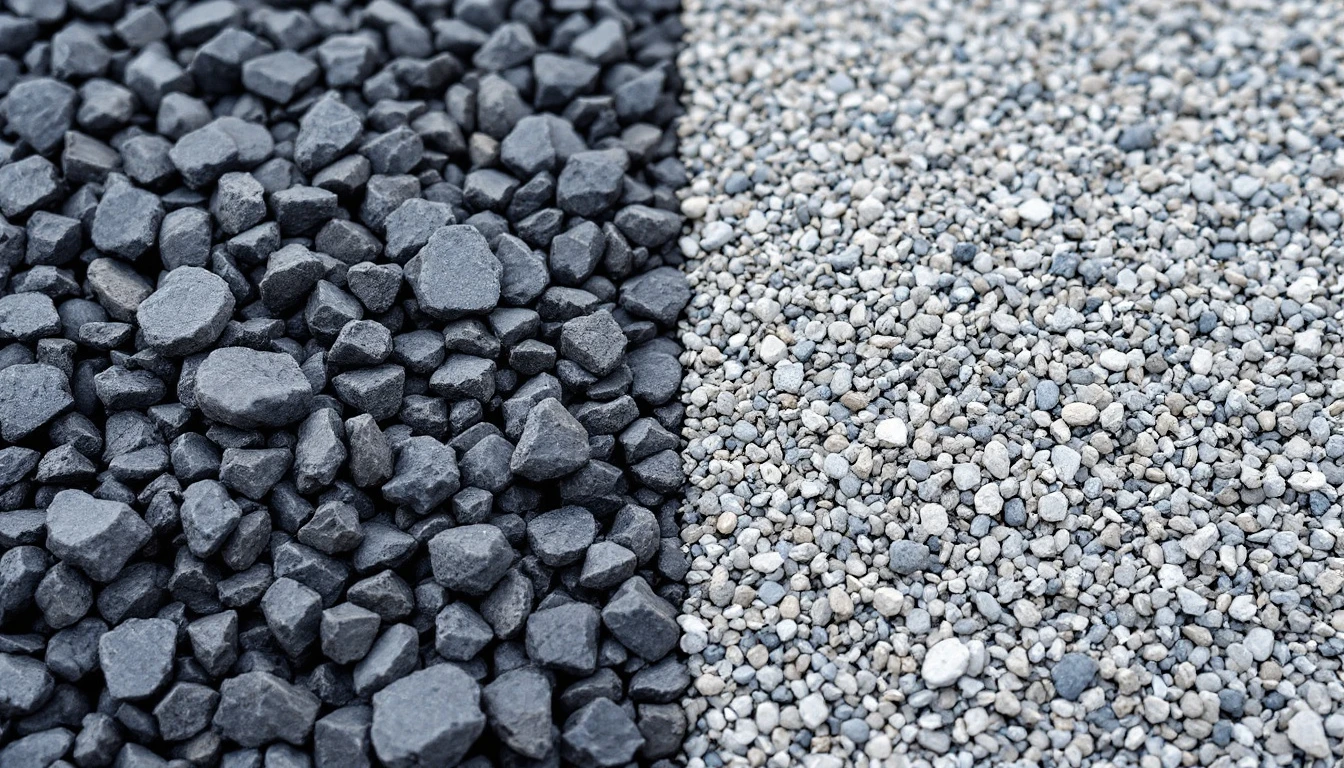
Picking aggregate for a driveway isn't just about grabbing whatever's cheapest or prettiest. The size and shape of the stone actually determines whether your driveway holds up under a truck, drains properly after a storm, or turns into a rutted mess by next spring. Aggregate isn't just a decorative topping you scatter over dirt. Done right, it's structural. The Federal Highway Administration points out that base and subbase layers made of graded aggregate are what carry the load, spread weight across the surface, and help water get out of the way instead of pooling underneath. This guide walks through the differences between fine, medium, and coarse aggregate, where each one earns its keep, and how to think about combining them for a driveway that actually lasts.
Why the Size of the Stone Matters
It's tempting to think of driveway gravel as one product with a few color options. But it isn't. Smaller particles pack tightly and lock gaps shut, which gives you a tidier surface. But that same tightness can choke off drainage. Bigger stone spreads load better and lets water pass through, but it's rougher underfoot and shifts more easily if it's not set up right.
Think about what your driveway actually has to survive. A commuter who parks a sedan there five days a week and occasionally hosts a visiting SUV needs something very different from a farm lane that sees pickup trucks, horse trailers, and the odd delivery van every week. Before you settle on a stone, it's worth thinking through:
- How heavy and how frequent the traffic is
- What kind of soil you're building on
- How much rain the site gets and where it drains
- Whether the ground freezes and thaws seasonally
- The slope of the driveway
- Whether the stone is doing base work, subbase work, or surface work
- What's going on top of it? Gravel, asphalt, pavers or concrete
Fine Aggregate: Good for Filling Gaps, Risky as a Whole Surface
Fine aggregate covers the smaller end of the spectrum, screenings, manufactured fines, and other finely crushed material. The exact particle sizes shift from one quarry to the next, so don't assume a bag labeled "fines" from one supplier matches another. Ask for the actual gradation sheet.
Advantages
Fines are handy for tucking into the small voids left by a properly compacted stone base. A contractor might spread a layer of fine material over a compacted crushed-stone base just to tighten things up and knock down that "loose gravel" look.
Disadvantage
Lean on fine material too heavily, then the drainage suffers. Once fines compact down, they can seal off the little channels water needs to escape through. The FHWA says gradation and fine content are closely tied to how well a pavement structure drains.
The Trade-Off
You get a smoother, tighter surface that's easier to walk on than sharp coarse stone. But overdo the fines and you're looking at dust clouds in July and a soupy mess in April, especially if the soil underneath already drains poorly.
Medium Aggregate: The Workhorse for Most Residential Driveways
For a standard residential gravel driveway, medium crushed stone is usually where people land. Crushed limestone, granite, and recycled aggregate all show up in this category in various gradations.
"Medium aggregate" is a loose, descriptive term, not a spec. A supplier's No. 57 stone follows its own defined gradation, it's not interchangeable with every other product someone happens to call "medium."
Why Homeowners Like It
Medium stone hits a sweet spot between stability, drainage, looks, and ride comfort. Angular crushed stone in particular has fractured, jagged faces that lock together once compacted. That mechanical grip is what gives you a stable surface, unlike smooth, rounded pea gravel that just rolls around under tires. For a typical car-and-light-truck driveway, a properly built aggregate base topped with the right surface material can hold up just fine day to day.
When It's Not Enough
Heavy trucks, regular trailer traffic, soft or unstable subgrade, or serious drainage problems can all overwhelm medium stone on its own. And no matter how good the surface stone looks on day one, it'll settle if the ground underneath it is weak. Fixing the foundation is the most important process.
Coarse Aggregate: Built for the Base, Not the View
Coarse aggregate is the big stuff. Larger crushed stone up through rock-sized material used in drainage work, depending on the spec. This is generally what you reach for when a driveway needs serious structural support or somewhere for water to go.
FHWA guidance lists crushed stone and similarly durable aggregates as standard picks for granular base and subbase construction, and notes that particle size and gradation directly affect stability, how well water moves through the layer, and resistance to frost heave.
Good uses for coarse stone:
- Building the subbase under a driveway
- Sites with weak, unstable, or problem soil
- Areas that regularly see heavy vehicles
- Drainage layers where open-graded material is called for
- Long rural driveways and access lanes
Coarse stone rarely makes a good driving surface on its own. Big stones are uncomfortable to walk on, a nightmare to plow snow off of, and prone to shifting under tires if they're not locked into the driveway structure properly.
How to Choose?
Start Underground, Not with the Stone
Before you pick anything, look at what's beneath the driveway. Soft clay, organic soil, or ground that holds water will need extra prep work no matter which aggregate you eventually choose. No amount of good stone fixes a bad subgrade, it just delays the problem.
Plan for Water Before You Plan for Looks
Water causes more driveway failures than anything else. Grade and shape the driveway so runoff actually moves away instead of collecting in low spots. Gradation matters here too. FHWA separates dense-graded aggregate from open-graded, permeable aggregate for a reason, how the particle sizes are distributed determines how much water the layer lets through.
Size the Aggregate to Your Actual Traffic
A driveway that sees two sedans a day doesn't need what a job-site access road needs. For normal passenger vehicles, a well-graded aggregate system usually provides plenty of stability. Heavier, more frequent traffic might call for a thicker base, better drainage, or even geosynthetic reinforcement, that's a site-specific call.
Factor in What's Going on Top
The base you build depends on what's going over it. Gravel, asphalt, concrete, and pavers don't share the same base requirements. For paved surfaces specifically, FHWA describes the base layer as the support system for whatever pavement course sits above it, it's not an afterthought, it's part of the structure.
Fine vs. Medium vs. Coarse: Quick Comparison
- Fine — Filling voids, select surface uses. Tight, smooth finish. Can choke drainage if overused.
- Medium — Residential surface or graded layer. Balances stability and usability. Can shift on steep or poorly built slopes.
- Coarse — Base, subbase, or drainage layer. Strong load support and drainage. Rough and uncomfortable as a top surface.
Treat this table as a starting point for the conversation, not a spec sheet. Always confirm actual particle sizes against your supplier's gradation documentation.
What Does Driveway Aggregate Actually Cost?
Honestly, there's no reliable national price-per-ton figure worth quoting. Costs swing too much based on where you live, which stone you're buying, the quarry, how much you're ordering, hauling distance, and local demand.
When you're comparing quotes, ask exactly what's included. Delivery? Grading? Spreading? Compaction? A stone that looks cheap upfront can end up costing more once you add hauling fees or pay for repeat maintenance down the line. Get a professional quote based on your driveway's real dimensions and site conditions, skip the generic online calculators.
Mistakes Worth Avoiding
- Picking stone purely because it looks good is a common trap. A gorgeous aggregate that doesn't suit your soil, traffic, or drainage situation will disappoint you fast.
- Using a single particle size for the entire driveway without thinking about what each layer is actually supposed to do. Good driveway design often mixes gradations, one for the base, another for the surface. Because each layer has a different job.
- And don't ignore standing water. If your driveway keeps developing potholes or ruts every time it rains, piling on more gravel is a band-aid. Fix the drainage, or you'll be back here again next season.
Final Thoughts
The right aggregate size comes down to how the driveway gets used, what's underneath it, where water wants to go, and what surface material will eventually sit on top.
Fine aggregate tightens up a finish. Medium aggregate handles most everyday residential driveways well. Coarse aggregate does the heavy lifting for base, subbase, and drainage work. None of them is universally "better". The goal is matching the right gradation to the right job, not just picking the biggest or smallest rocks available.
If you're planning a new driveway, a resurfacing job, or a full replacement, Drivewayz USA can help you turn these considerations into an actual plan. Head over to Drivewayz USA to check out more driveway guides and get your project moving.
Frequently Asked Questions
There isn't one universal answer. A well-graded mix of sizes usually outperforms a driveway built from a single particle size. What's "best" depends on your soil, drainage, slope, traffic, and intended surface.
Coarser, open-graded stone typically drains better when it's specifically chosen for that purpose. Too much fine material can restrict water movement. In the end, the overall gradation design matters more than any single particle size.
Sometimes, but it's usually a rough, uncomfortable ride and the stones can shift more under traffic. Most of the time, coarse stone works best as a base or subbase, with something finer laid on top.
It varies. Soil strength, climate, drainage, traffic volume, the aggregate itself, and the planned surface all factor in. Heavy use or weak soil usually means a thicker, more substantial base.
Yes. If it's part of the driveway's structure, it should be placed and compacted deliberately, not just dumped and driven over. Proper compaction is what keeps the surface from settling or rutting later.