
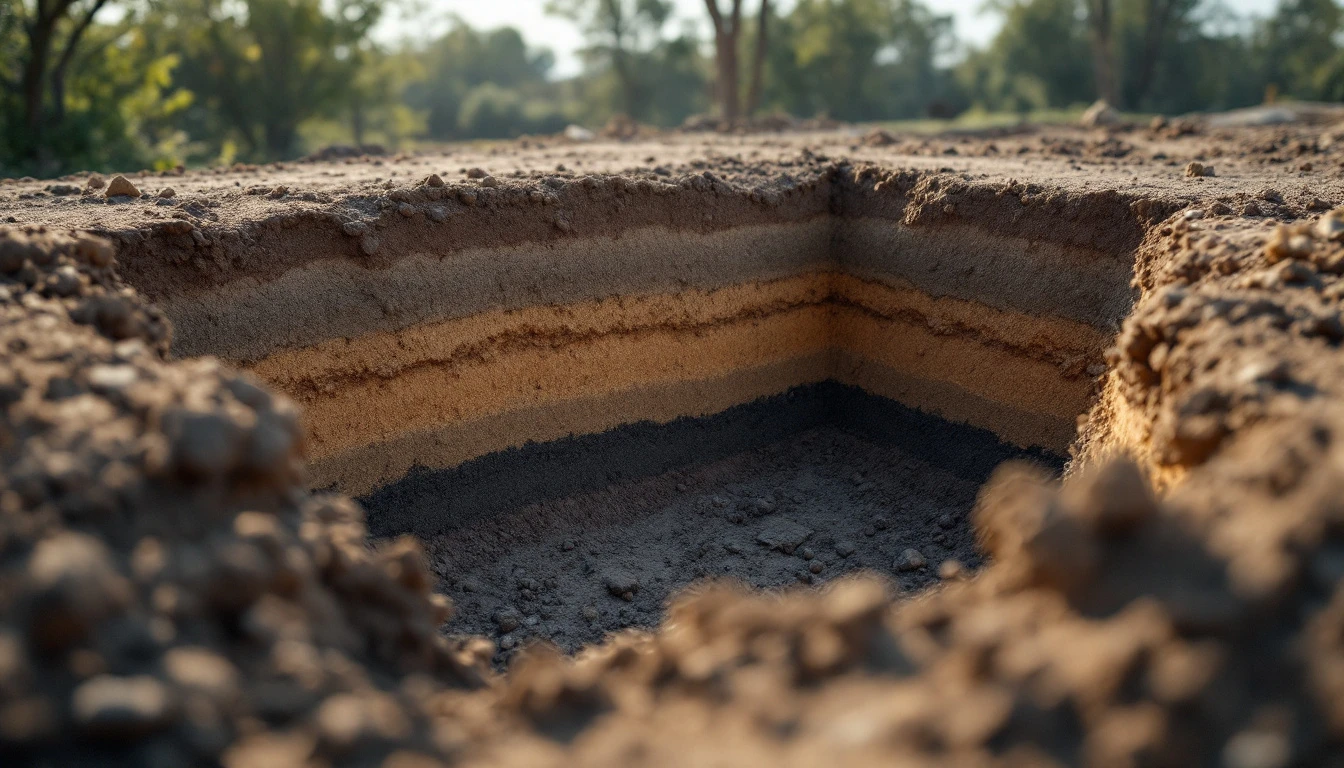
You can pour the best concrete or lay the nicest pavers money can buy, and your driveway can still crack, sink, or turn into a rutted mess within a few years. Nine times out of ten, the real problem isn't what's on top, it's what's underneath. That's the whole idea behind a driveway geotechnical assessment. Rather than focusing on asphalt mix or paver style, it looks at the dirt itself. How wet it gets, how well it drains, how compacted it is, and whether it can actually hold up a driveway over time. For most homeowners, it comes down to one simple question: what are you actually building on?
Why Soil Even Matters for a Driveway
A driveway isn't just a slab or a layer of asphalt sitting on the ground. There are usually base and subbase layers underneath, and all of that rests on the native soil, what engineers call the subgrade.
When that subgrade is weak, spongy, poorly compacted, or prone to soaking up water, the driveway above it can shift and move even if every other part of the job was done right. The Federal Highway Administration points to unsuitable subgrades, moisture, expansive soils, and drainage problems as major contributors to pavement failure. Because water saps the strength out of soil and base materials, which leads to settlement, rutting, and cracking down the line.
What Is a Driveway Geotechnical Assessment?
Think of it as a deep-dive into the ground your driveway will sit on, not a quick garden soil test, but a real evaluation of whether that soil can carry a pavement structure, and what needs to happen if it can't. Depending on the site, this might involve:
- Walking the site and reviewing the driveway's planned layout
- Looking at existing grading and how water currently moves across the property
- Digging into the soil layers beneath the surface
- Testing soil strength and moisture levels
- Flagging fill, organic material, or soft spots that shouldn't be there
- Checking for expansive or moisture-reactive clay
- Recommending how to prep the subgrade and support the pavement
- Putting it all into construction-ready recommendations
How deep that investigation needs to go really depends on the job. A short residential driveway on flat, dry ground doesn't call for the same scrutiny as a large commercial lot, a qualified professional should be the one making that call.
The Soil Conditions That Tend to Cause Trouble
Not every yard needs a full-blown investigation, but a few red flags are worth knowing about.
Soft or Spongy Ground
If a section of your yard stays mushy after it rains, or feels unstable when you walk on it, that's usually a sign of poor bearing capacity or too much retained moisture. Left alone, that soft spot can deform under the repeated weight of vehicles, leaving you with dips and ruts right where tires roll.
Expansive Clay
Some clay soils swell up when they're wet and shrink back down as they dry out. That constant push-pull can crack pavement over time. The FHWA calls out expansive soils as a real geotechnical concern, and typically recommends dealing with them through removal and replacement, stabilization, better moisture control, or another engineered fix suited to the site.
Uncontrolled Fill
Picture a yard where several feet of soil were brought in just to level things out. If that fill wasn't placed and compacted properly, in controlled layers, it can compress later under the added weight of a driveway and the traffic on it.
Organic Soil
Topsoil and other organic material simply aren't built to hold structural weight. It breaks down and shifts over time, which makes it nearly impossible to keep a driveway's foundation uniform.
Wet or Saturated Soil
Water might be the single biggest factor in how long a driveway lasts. Soil that seems perfectly capable when it's dry can lose a lot of its strength the moment it's saturated. According to the FHWA, saturated subgrades are a common culprit behind depressions, rutting, and cracking.
How the Assessment Gets Done
The specifics shift depending on the site, the driveway's size, the paving material, and what kind of soil issues are suspected going in, but it generally breaks down into four stages.
- Site review: A geotechnical professional starts by walking the property and looking at the proposed driveway path, existing grades, drainage patterns, and anything else the site tells them. Old cracks, standing water, retaining walls, slopes, and areas of visible fill all offer clues before a single test is run.
- Digging into the subsurface: From there, they'll typically use test pits, hand augers, borings, or similar methods to see what's actually going on below the surface. There's no fixed formula for how many holes to dig or how deep. A simple, flat, dry lot might need very little, while a steep or previously filled site could call for a lot more exploration.
- Lab testing: Once samples are collected, testing can measure things like moisture content, density, compaction, plasticity, and overall strength. This is often where you'd find out, for instance, whether a clay-heavy soil is prone to significant swelling and shrinking.
- Recommendations you can actually build from: The final piece is turning all that data into something usable. Provide guidance on subgrade prep, base thickness, whether unsuitable soil needs to be removed and replaced, compaction targets, stabilization methods, geosynthetics, or drainage fixes. A good report should read like a set of instructions your contractor can follow, not just a stack of lab numbers.
Can You Spot Soil Problems Yourself?
To a point, yes. Keep an eye out for spots that never quite dry out, soft patches after a storm, past settling, odd cracking patterns, exposed roots, pooling water, or any hint that the property has old fill sitting under it.
Those observations are genuinely useful. They're often what prompts someone to call a professional in the first place. But eyeballing soft dirt and knowing whether it can support a driveway's weight are two very different things. Sometimes it needs testing and engineering judgment.
When Is It Worth Getting an Assessment?
A geotechnical assessment tends to pay for itself when:
- The driveway will sit on a steep slope
- The property has significant fill
- Drainage or standing water has been a recurring headache
- An existing driveway keeps settling or cracking
- The ground feels soft or unstable
- There's a chance of expansive clay
- The driveway will carry heavy or frequent vehicle traffic
- The project involves major excavation or grading
- A local authority, engineer, or spec sheet requires it
Drainage Is Really Part of the Same Problem
Good soil alone won't save a driveway if water has nowhere to go. The design needs to move water away from the pavement instead of letting it pool underneath, which might mean surface slopes, grading changes, gutters, swales, edge drains, or subsurface drainage, depending on the property. The FHWA's guidance is pretty clear on this, controlling how much water gets into a pavement system is just as important as what the pavement itself is made of.
Take a downspout that dumps water right next to the driveway edge every time it rains. Pouring a thicker slab won't fix that, the water still has to go somewhere. The drainage issue needs to be solved as part of the overall design, not patched over with more pavement.
What Does This Cost?
Honestly, there's no clean national average to point to. Price depends on where you live, how easy the site is to access, how many test points and how deep they go, whether lab testing is involved, the terrain, and how detailed the final report needs to be.
A basic residential job on an accessible, straightforward lot will run a lot less than a difficult site that needs drilling equipment, extensive lab work, and detailed engineering write-ups. Rather than chasing an average number, it's worth getting a written scope and quote from a local professional and judging that quote by whether it gives you useful information, not just by the price tag.
What to Ask When Hiring Someone
Make sure whoever's giving you engineering recommendations is properly licensed for the work and the location, that part isn't optional. Beyond that, it's fair to ask what kind of investigation they're proposing, what testing they'll run, what the final report will actually include, and whether their recommendations are tailored specifically to your driveway project rather than boilerplate. It's also worth asking upfront how they'd handle it if something unexpected turns up mid-construction, because that happens more often than people expect.
Don't Forget the Paperwork
Driveway projects aren't purely a construction question. Depending on where you live, they can also involve permits, drainage rules, right-of-way requirements, grading regulations, or HOA approval. These vary a lot by municipality, so it's worth checking with your local authority before anything gets built, and confirming whether engineering documentation is required for your project.
If a geotechnical report is going to be required anyway, getting it done before contractors submit their bids tends to work out better. It means the bids actually reflect what the site needs, instead of guesswork.
Final Thoughts
A driveway can look like the simplest thing on a property, but how long it lasts depends heavily on what's happening below the surface. Understanding the soil ahead of time, weak spots, expansive clay, old fill, moisture issues, poor drainage, means catching problems while they're still cheap to fix, instead of after the pavement's already cracked.
At Drivewayz USA, we think that understanding what's under a driveway is just as important as what goes on top of it, whether you're planning something new, replacing a driveway that's failing, or trying to get ahead of settlement and drainage issues you're already dealing with. A driveway is only as good as the ground it's sitting on.
Frequently Asked Questions
It's an evaluation of the soil and subsurface conditions under a driveway, meant to catch issues like weak soil, expansive clay, bad fill, excess moisture, or drainage problems before they turn into pavement damage.
No. A straightforward driveway on flat, well-drained, stable ground usually doesn't need a detailed investigation. It becomes more worthwhile when there's a slope, fill, soft soil, drainage trouble, past settlement, or suspected expansive clay involved.
Yes. Weak or poorly compacted soil leads to uneven support and settlement, while expansive soils swell and shrink with moisture changes, both of which can show up as cracking or depressions in the pavement above.
Yes. Excess water weakens both the subgrade and the unbound base materials beneath the pavement. Proper grading, and sometimes surface or subsurface drainage, helps keep water from undermining the driveway over time.
Ideally, before the driveway design and construction scope are finalized, soil, grading, and drainage findings can actually shape the plan instead of being dealt with after the fact.