
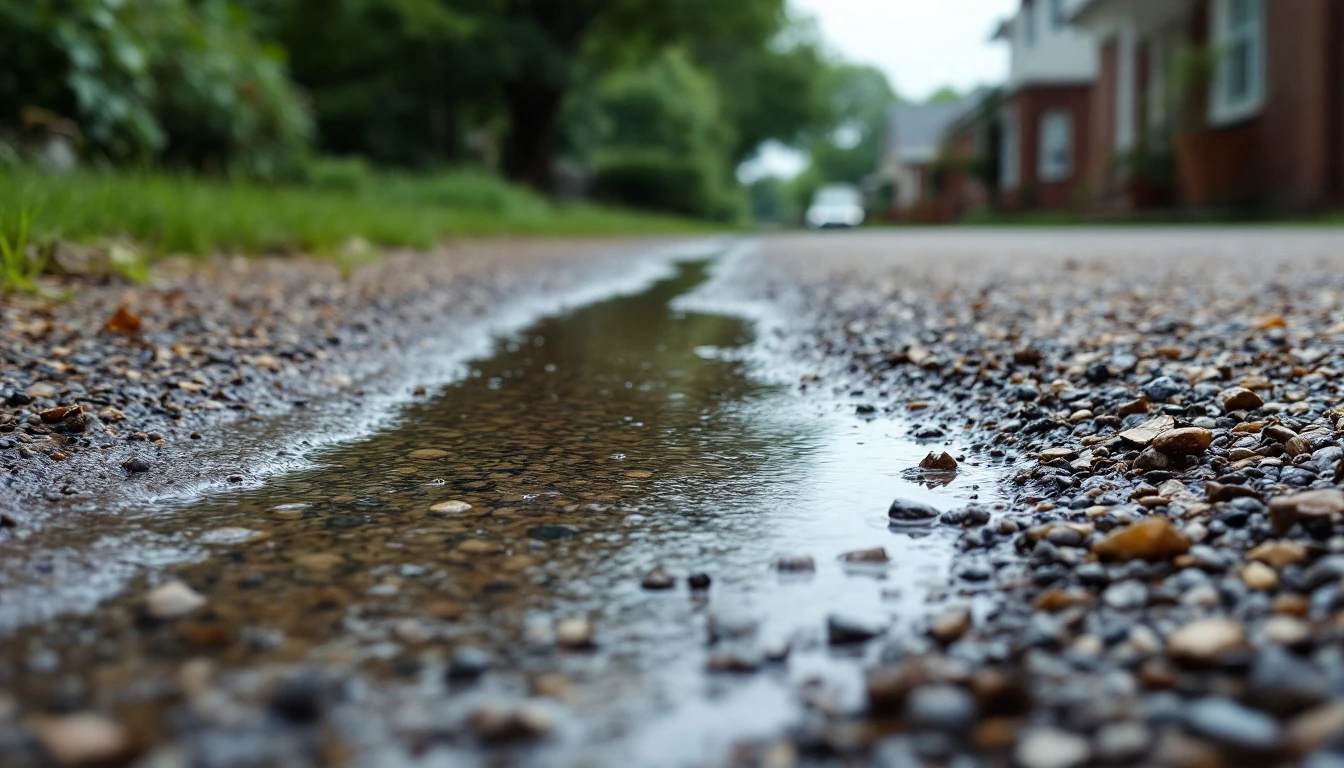
If your driveway turns into a shallow pond every time it rains, you already know it's more than a cosmetic annoyance. Standing water eats away at the base underneath, drags loose material off with it, leaves slick spots, and over a season or two you start seeing cracks, ruts, and sunken patches. So when people ask about a budget driveway for a flood-prone lot, it comes with a lot of considerations. It's not really about finding the cheapest surface you can get away with. It's about pairing an affordable material with grading and drainage that actually work together. Which driveway material fits for your property comes down to a handful of things: how much water actually reaches the driveway, what kind of soil sits underneath it, how the land slopes, how much rain your area gets, and how hard you're going to be using the surface day to day.
Why Does a Driveway Flood in the First Place?
Usually because of water running downhill from a higher part of the yard and pooling once it hits the driveway. It might be settling into a natural low point. Or it might just have nowhere to go once it lands on a surface that doesn't let anything through. The age of the driveway plays a role too. Even a driveway that was built reasonably well can develop dips over the years as the base settles, and those dips become little reservoirs every time it storms.
Example
Picture a house sitting toward the bottom of a lot with a gentle slope. During a heavy rain, water pours off the roof and lawn and heads straight for the driveway. If that driveway is flat and hemmed in by raised edges on either side, the water just sits there, no way out until it evaporates or finds some other path. That's really the core issue, and it's why drainage has to be part of the conversation alongside whatever material you end up choosing.
Best Driveway Materials When Flooding Is the Problem
There isn't one "correct" material that beats all the others. It really depends on what you're optimizing for. Water infiltration, upfront cost, how much weight the surface needs to hold, how much upkeep you're willing to do, and how long you want it to last all pull in slightly different directions.
Gravel
Gravel gets brought up a lot because it's cheap and, unlike poured concrete or standard asphalt, water can actually work its way down through the gaps between the stones. That's a real advantage.
But don't mistake gravel for a fix-all. Fast runoff, especially on a slope or wherever water tends to concentrate, will happily wash loose stone right off the driveway. To keep gravel where it belongs, you need a properly prepped subgrade, enough base material underneath, some kind of edge containment, and a plan for where the water goes once it hits the surface.
Permeable Pavers
These are interlocking pavers laid with gaps and a supporting layer of aggregate underneath, built specifically so rain can pass through rather than run off. They look more finished than gravel and cut down on surface runoff at the same time, which is appealing. The tradeoff is that they take more planning and more labor to install correctly, so expect the upfront cost to run higher than a basic gravel job.
Pervious Concrete
This is concrete poured with interconnected voids built into it, so water drains straight through into the aggregate layers below instead of sitting on top. It's a solid option for driveways where managing stormwater is a real priority, not an afterthought.
Pervious concrete only works if it's installed correctly. Pouring a "water-permeable" product over a poorly prepared base doesn't magically solve drainage, the system underneath has to be right.
Porous Asphalt
Porous asphalt works on a similar principle to pervious concrete but with an asphalt surface instead. Water moves through the pavement itself and down into a stone reservoir built underneath it, rather than conventional asphalt's more sealed-off approach.
The Federal Highway Administration has noted that well-designed permeable pavements can help stormwater soak in, cut down on runoff, and reduce peak flow during storms. That makes porous asphalt worth a look for certain flood-prone driveways, though it needs proper site evaluation and professional design to actually deliver.
Improving a Flood-Prone Driveway Without Starting Over
You don't always have to tear the whole thing out. If the existing driveway is still structurally sound, tackling the drainage side of things can solve a big chunk of the problem on its own.
Fix the Grade
Water needs a direction to travel in. A driveway that's developed a dip will hold water even if the rest of the property drains just fine. Regrading can push water away from your garage or house instead of toward it. What slope you actually need depends on your site, your surface material, and any local codes .
Add a Channel or Trench Drain
If water keeps crossing the driveway from one side to the other, a drain positioned in the right spot can catch it before it pools. Remember a drain only works if the water it collects has somewhere sensible to go afterward. Installing one without a discharge plan just relocates the puddle a few feet over.
Look into a French Drain or Swale
A French drain handles subsurface and surface water depending on your site. A swale, a shallow, landscaped channel can redirect runoff in a way that fits into the yard rather than looking like an add-on. Either can be a more practical move than ripping out a driveway just because water happens to collect on it.
Don't Neglect the Base
Everyone focuses on the surface, but the layers underneath matter just as much. A poorly compacted or wrong-for-the-job base material will settle over time and create exactly the kind of depressions that hold water. For any new build or major redo, a contractor should be looking at the soil, the drainage situation, the base aggregate, compaction, and how much vehicle weight the driveway needs to handle.
Mistakes While Installing a Flood-Prone Driveway
Trying to cut corners here usually backfires if the actual drainage problem never gets addressed. Don't just dump more surface material over a spot that keeps sinking. It might look better for a season, but water will keep pooling underneath regardless.
Don't reroute runoff toward a neighbor's yard, your own foundation, a sidewalk, or anywhere else it'll just cause a new headache. And check local rules before you make changes, many places regulate how runoff can legally leave a property.
And don't pick a material purely because it's the cheapest number on the quote. A surface that needs constant patching or loses material every time it storms often ends up costing more over the years than something pricier up front.
How to Choose a Flood-Resistant Driveway
Start by tracing the water back to its source. Is it landing directly on the driveway, running downhill from the yard, dumping out of a downspout, or coming in off the street? Then figure out where it can safely go once it's off your driveway. Only after that should material even enter the conversation.
A homeowner dealing with moderate runoff on a relatively flat, stable lot might do fine with gravel or a permeable system. Someone on a steep property with runoff funneling toward one spot probably needs drainage work and a tougher surface before material choice becomes the main decision at all. More often than not, the cheapest long-term fix is the one that deals with the source of the flooding, not the one you keep re-patching every spring.
Final Thoughts
A budget driveway on a flood-prone lot doesn't have to mean picking the lowest price tag and hoping it holds up through the next storm. Real affordability starts with understanding where the water's coming from, fixing whatever's causing it to collect, and choosing a surface that actually fits the property.
If you're weighing materials, drainage approaches, and installation options, Drivewayz USA can help you sort through the decision. The right driveway isn't the one with the lowest installation quote, it's the one that fits your property, holds up to everyday use, handles water the way it needs to, and keeps performing years down the line.
Frequently Asked Questions
There's no universal answer. Gravel, permeable pavers, pervious concrete, and porous asphalt can all help manage stormwater, but which one makes sense depends on your soil, slope, drainage, traffic, and climate.
It can be. But gravel drains well and tends to be budget-friendly. Just know that fast or heavy runoff can wash it away if you don't have proper grading, a solid base, and some drainage control in place.
Often, yes. If the driveway's still structurally good, improving nearby drainage, patching low spots, or adding a well-placed drain can go a long way. Have a contractor check for the root cause before assuming you need a full replacement.
No, it helps by letting water pass through the surface rather than run off, but it can't override every limitation your site has. Soil type, groundwater levels, rainfall intensity, and how well the system is maintained all factor into how well it actually performs.
Look at the slope, existing drainage patterns, soil type, where the water's coming from, the driveway base, any local regulations, and where runoff will ultimately end up. Sort all of that out before you settle on a surface material.