
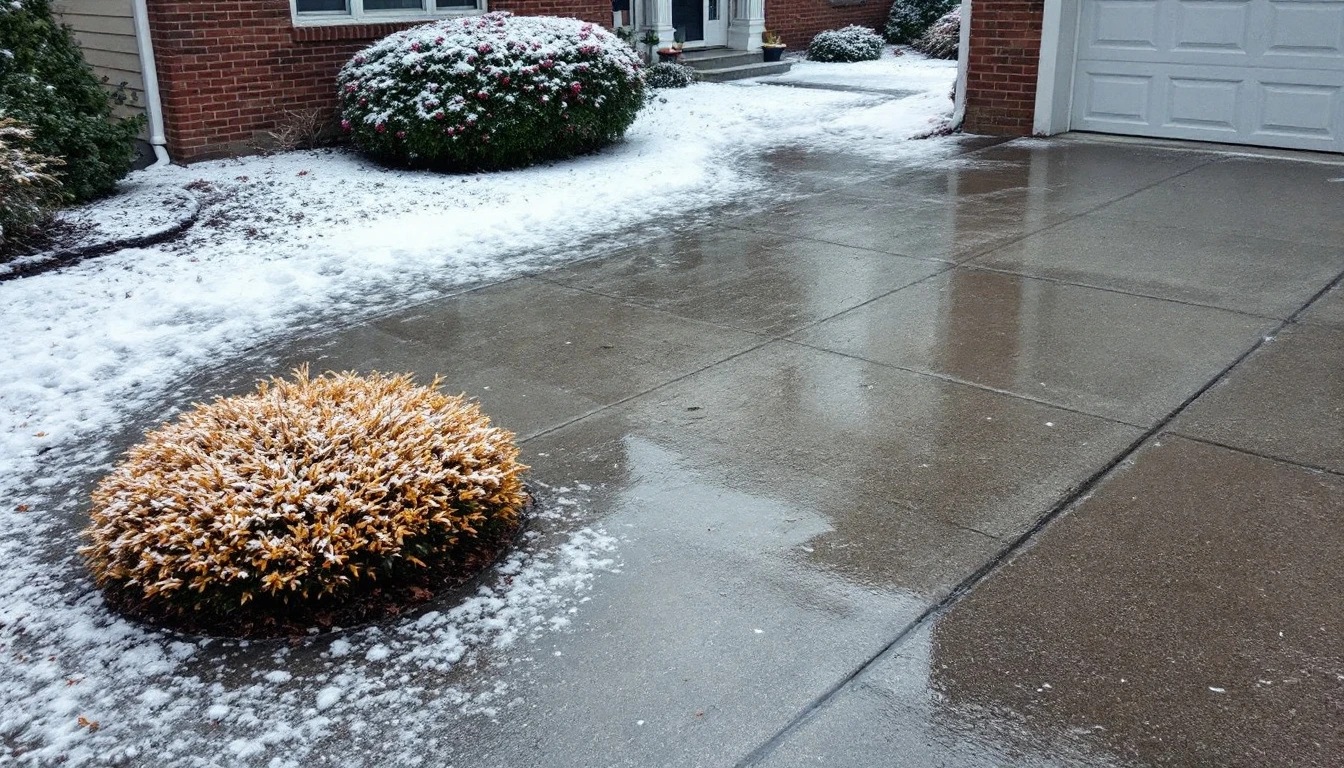
If you live in a region where harsh winters are frequent like the ice that doesn't quit until March, picking a driveway material isn't just an aesthetic or easy decision. Get it wrong and you're looking at cracked slabs, heaving edges, or a surface so slick you're gripping the mailbox just to get to your car. Cheap upfront doesn't always mean cheap over time. A driveway that looks like a bargain in October can turn into a spring full of patch jobs and regret. This guide walks through what actually holds up when the temperature swings from 40 degrees to well below freezing and back again, sometimes in the same week.
Why Snow and Ice Are Extremely Hard on Driveways
Cold climates put a specific kind of stress on pavement that milder regions never deal with. A few things are working against your driveway all winter long:
- Water seeps into tiny cracks, freezes, expands, and widens them, do that enough times and a hairline crack becomes a pothole
- Ice sheets form on anything that doesn't drain well, turning a walkway into a hazard
- Plow blades chew up loose or poorly compacted surfaces
- Standing water that refreezes overnight just repeats the whole cycle
None of this means you need to spend a fortune. It means the material you pick has to be chosen with winter friendly in mind, not just curb appeal.
What to Actually Look For
Before you settle on anything, run it through these filters:
Can it handle expansion and contraction? Rigid materials that can't flex even slightly tend to crack first.
Does water move through or off it? Standing water is enemy number one in freeze-thaw climates.
Will you be able to walk on it without falling? Smooth, polished surfaces get treacherous fast once ice sets in.
What's the real cost over ten years? A driveway that needs yearly repairs isn't actually saving you anything.
Can a plow work it without tearing it apart? Some surfaces just aren't built for a steel blade scraping across them every storm.
Material Breakdown
Gravel Driveway
Gravel remains one of the go-to choices for people trying to keep costs down in places like Minnesota, upstate New York, or rural Canada.
Why It Holds Up
Loose stone drains almost instantly, so there's less water sitting around to freeze. It also shifts slightly with the ground instead of fighting it, which helps during freeze-thaw cycles.
What's good about it:
- Cheapest option to install by a wide margin
- Drains better than almost anything else on this list
- Fixing a rutted or worn patch is a weekend job, not a contractor call
Where it falls short:
- Needs regrading every year or two
- Plows can push it around, leaving bare patches
- Steep driveways cause the stone to migrate downhill
A lot of homeowners in colder rural areas just accept the annual raking and regrading as part of owning a gravel driveway, it's a small trade-off for something that basically never cracks.
Asphalt Driveway
Asphalt strikes a middle ground, it's not the cheapest thing out there, but it gives you a smooth, plowable surface without the price tag of concrete.
Why It Holds Up
It has just enough give to absorb the stress of freezing and thawing instead of snapping under it. The dark surface also pulls in sunlight, which helps melt snow faster than lighter-colored materials.
What's good about it:
- Flexes instead of cracking through most freeze-thaw cycles
- Melts snow quicker thanks to heat absorption
- Plows glide across it without much resistance
Where it falls short:
- Needs resealing every few years or it starts to deteriorate
- Gets soft and vulnerable in intense summer heat
This is why so many suburban developments across the northern U.S. default to asphalt. It is the material snowplow crews are used to dealing with, and it doesn't punish you for one missed sealing cycle the way some surfaces do.
Crushed Stone
Think of crushed stone as gravel's more disciplined cousin. The stones are angular rather than rounded, so they interlock instead of rolling around.
Why It Holds Up
That interlocking effect creates a firmer, more stable base while still letting water pass through.
What's good about it:
- Still budget-friendly
- More traction underfoot than smooth gravel
- Doesn't shift as much as loose stone
Where it falls short:
- Heavy or repeated plowing can still displace it over time
- You'll need to top it off occasionally as it settles
Tar and Chip
This one's a bit of a hybrid, liquid asphalt sprayed down and topped with crushed stone, pressed together into a textured surface.
Why It Holds Up
The rough texture gives you extra grip exactly where you need it: on ice.
What's good about it:
- Cheaper than a full asphalt install
- Excellent traction in icy conditions
- Has a rustic, textured look some homeowners actually prefer
Where it falls short:
- Doesn't last as long as straight asphalt
- Not every contractor in every region offers it
Concrete Driveway
Concrete rarely gets filed under "budget," but it earns a place on this list because of how the math works out over 20 or 30 years.
Why It Holds Up
If it's done one right with proper reinforcement and expansion joints, concrete shrugs off decades of winters with very little intervention.
What's good about it:
- Can outlast every other option here by a wide margin
- Barely needs upkeep once it's cured and sealed properly
- Handles heavy vehicles without rutting or shifting
Where it falls short:
- Highest cost to install
- A sloppy installation without expansion joints will crack under freeze-thaw pressure, no matter how good the concrete itself is
Homeowners in places like Chicago who spend the extra money on a properly reinforced slab often go decades without a major repair. The upfront cost stings, but the total lifetime spend can end up lower than materials that need constant patching.
Quick Comparison
- Gravel — low cost, good winter performance, medium upkeep, medium lifespan
- Asphalt — medium cost, very good winter performance, medium upkeep, medium lifespan
- Crushed stone — low cost, good winter performance, low upkeep, medium lifespan
- Tar and chip — medium cost, good winter performance, low upkeep, medium lifespan
- Concrete — high cost, very good winter performance, low upkeep, long lifespan
Making Whatever You Choose Last
The material only does half the work. A few habits go a long way no matter what surface you pick:
- Grade it properly: If water can't run off, it'll find a crack to sit in and freeze.
- Don't skimp on the base layer: A weak foundation causes more failures than the surface material ever does.
- Watch your plow technique: Rubber-edged blades or a slightly raised blade height spare the surface from unnecessary gouging.
- Reseal on schedule: if you've gone with asphalt or tar and chip, skipping this is the fastest way to shorten its lifespan.
- Patch small cracks immediately: A crack you ignore in November is a pothole by March.
Mistakes That Cost People Money Later
- Picking the cheapest bid without factoring in local climate
- Rushing or skipping the base prep to save a day of labor
- Not planning drainage before the surface goes down
- Choosing a smooth finish that turns into a skating rink
- Letting small cracks sit "until spring"
Final Thoughts
There isn't one universal answer for Best Budget Driveway Materials for Heavy Snow Regions. It really comes down to your budget, your slope, how much upkeep you're willing to do, and how brutal your winters actually get. Gravel and crushed stone win on upfront cost and drainage. Asphalt is the sweet spot for people who want something smoother that still handles freeze-thaw cycles well. Concrete costs more today but can quietly save you money over several decades if it's installed correctly.
Whatever you land on, the driveway that "wins" in heavy snow country is rarely the cheapest one, it's the one matched properly to your climate and put in with a solid base underneath it.
For more comparisons and contractor insights, you can check out additional resources at Drivewayz USA.
Frequently Asked Questions
Gravel typically comes in lowest, and its natural drainage plus flexibility make it a solid performer through winter.
Asphalt tends to flex with freeze-thaw cycles better, while concrete, if not installed with proper joints, is more prone to cracking.
Good drainage, timely crack sealing, and occasional de-icing products all help cut down on ice buildup.
Yes, loose gravel and poorly installed surfaces are especially vulnerable. Proper blade height and rubber edges reduce the risk.
Roughly once a year at minimum, with a closer look right after winter to catch anything that needs attention early.