
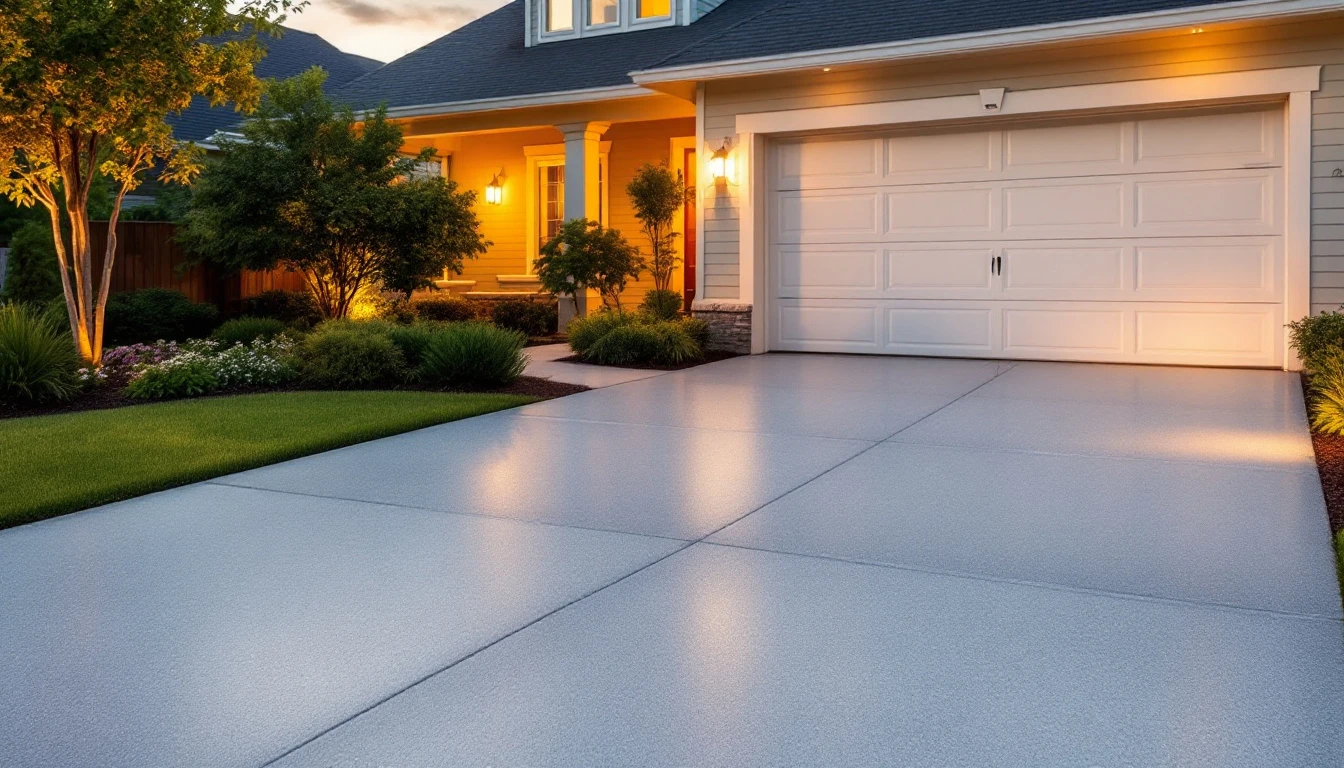
If you're thinking about a new driveway and want a straight answer to a simple question: what's this going to cost? Unfortunately, there isn't a single number that works for every property. Concrete itself is only part of the equation, size, excavation, soil, drainage, reinforcement, old driveway removal, finish choice, site access, and local rules all push the final price up or down. In 2026, a reasonable planning range for a standard residential concrete driveway in Rhode Island is about $10 to $16 per square foot. Real quotes can land outside that band depending on your site, but it's a solid starting point. A 600-square-foot driveway, for instance, would run roughly $6,000 to $9,600 excluding extra site work, upgraded finishes.
What Does a Concrete Driveway Cost in Rhode Island Right Now?
For a typical driveway with a basic broom finish, approximately costs from $10- $16 per square foot If your driveway is 20 feet by 30 feet: 20 × 30 = 600 square feet. At the low and high ends of the range:
- 600 × $10 = $6,000
- 600 × $16 = $9,600
If your property needs heavy excavation, removal of an old driveway, drainage fixes, has tricky access, or you want decorative concrete, expect the number to climb well past that range.
What Actually Drives the Price Up or Down
The most common mistake people make when shopping driveway quotes is focusing only on the concrete. In reality, a driveway is a full construction system — the slab is just the visible part.
Size and Shape
More square feet means more concrete, more base material, and more labor, which is fairly intuitive. What surprises people is how much shape matters. A straight two-car driveway is much simpler to build than a curved one, a circular one, or one with elevation changes. Complex layouts need more forming and more careful grading, so two driveways with similar square footage can end up priced quite differently.
Removing an Old Driveway
If there's existing asphalt or concrete that needs to be taken out first, that's an extra phase of the project, demolition and disposal.
Old concrete tends to be the tougher of the two to deal with, since it usually has to be broken up before it can be hauled off. Limited access to the site can push costs up further. And if the old driveway has serious settlement, drainage problems, or a weak base underneath, patching a new surface over it usually isn't a good long-term fix, rebuilding the foundation from scratch tends to make more sense.
The Ground Underneath
Concrete needs something stable to sit on. That often means excavating soil that won't hold up and replacing it with compacted crushed stone or another suitable base. Rhode Island sites vary. Clay-heavy soil, poor drainage, fill dirt, sloped lots, and areas that catch a lot of runoff can all mean extra prep work. This matters even more here than in milder climates, since freeze-thaw cycles are hard on a driveway that doesn't have a solid foundation.
Thickness and Reinforcement
Most residential driveways are built around a 4-inch slab, but that's a starting assumption, not a rule. If the driveway regularly has to handle heavy trucks, trailers, or RVs, a thicker slab or added reinforcement may be the right call, and your contractor (or an engineer, for unusual loads) should weigh in on that.
Whatever you do, make sure any quotes you're comparing use the same thickness, mix specification, reinforcement, base prep, and finish. A cheaper number doesn't mean much if it's missing pieces the higher quote includes.
How Much Does the Finish Change the Price?
A plain broom finish is generally the most affordable route and still gives you a durable, practical surface. If you want something with more personality, options include:
- Colored concrete
- Stamped concrete
- Decorative borders
- Exposed aggregate
- Custom patterns or textures
These all cost more, they need extra materials, extra prep, and extra time on the finishing side. If budget is the main concern, sticking with a standard finish gets you a clean-looking driveway without paying a premium for decorative work.
Bottom Line
check local and state requirements before you assume you can build wherever you'd like on your property.
Concrete vs. Other Materials
Concrete isn't your only option. Asphalt usually costs less upfront and remains a popular residential choice. Gravel is typically the most budget-friendly route where it's a good fit for the site and local rules allow it. Pavers give you the most design flexibility but usually carry the highest initial price tag.
Picking the right material comes down to more than just what it costs to install. Think about how much traffic the driveway will see, how water drains across the property, how much upkeep you're willing to do, how it'll look, how it holds up to snow and ice, and what your slope looks like. A flat lot and a tight budget might point toward gravel. Someone who wants a finished, long-lasting surface is probably better off with concrete.
When's the Right Time to Pour?
Weather plays a real role here. Late spring through early fall tends to give you the most predictable conditions for concrete work. Cold weather complicates placement and curing, and extreme heat or fast-swinging temperatures require extra care too.
Timing your project also matters because contractors book up fast once the warmer months hit. Planning ahead gives you more room to compare bids and lock in a good installation window, rather than settling for whoever happens to be free.
Rather than picking a contractor just because they can start tomorrow, look at their process, materials, warranty terms, and prep work.
Getting a Quote You Can Actually Trust
Before you sign off on any estimate, make the contractor list out exactly what's included. A solid quote should cover:
- Total square footage
- Concrete thickness and mix specification
- Base preparation
- Reinforcement (if needed)
- Demolition and disposal
- Drainage or grading work
- Finish type
- Expansion and control joints
- Who's responsible for permits
- Cleanup and final grading
Ways to Keep Costs Down
You don't need every premium feature to end up with a driveway that looks good and lasts. Keeping the layout simple, going with a standard finish, handling site prep efficiently, and getting several detailed quotes all help keep the number reasonable.
If you have to choose where to spend, put the money into proper grading and base work rather than decorative extras. A pretty driveway sitting on a bad foundation is a problem waiting to happen.
Taking Care of It Afterward
Concrete doesn't ask for much, but it's not entirely maintenance-free either. Keep debris from building up on the surface, deal with cracks or damaged joints before water gets a chance to work its way in, and go easy on de-icing products in winter. Heavy use of aggressive deicers can wear down the surface over time.
A driveway built with real attention to drainage and a solid base is going to outlast one where corners were cut to save money upfront.
Final Thoughts
The real cost of a concrete driveway in Rhode Island comes from the whole project, not just the price per square foot of concrete. Also excavation, demolition, drainage, reinforcement, access issues, and finish choice can all move the prices up or down..
Before settling on concrete, asphalt, gravel, or pavers, think through how the driveway will actually be used and how your property handles water. Good prep and drainage tend to pay off more over time than chasing the lowest bid.
If you're planning a new driveway or a replacement, Drivewayz USA has resources to help you understand your options before you commit. Contact us to get a professional estimate.
Frequently Asked Questions
Plan on roughly $10 to $16 per square foot for a standard residential driveway. That puts a 600-square-foot driveway around $6,000 to $9,600, before factoring in unusual site conditions, demolition, drainage work, or decorative finishes.
Gravel usually wins on upfront cost. That doesn't automatically make it the right choice, factors like drainage, slope, maintenance, local rules, and how you want the finished product to look matters too.
It depends on your project and where you live. RIDOT specifically requires a permit for any driveway connecting to a State Highway Right-of-Way, and your local municipality may have its own requirements too. Check before you start.
Yes, as long as it's designed, installed, graded, and cured properly. Given the freeze-thaw cycles here, good drainage and a solid base aren't optional extras. They keep the driveway from cracking and heaving.
Measure your driveway area, figure out if an old driveway needs to come out, and get detailed written quotes from a few qualified contractors. Make sure every quote is working from the same specs, thickness, reinforcement, prep, finish, drainage, cleanup.